No Iterations
Lisp and Clojure enhance interactive, idea-driven programming.
One day we will boot up our computer and it asks What is my purpose?.
One magic piece of Lisp is the concept and idea of interactively building the program while it is running. The interaction layer between the program and programmer is implemented by a read-eval-print loop, the REPL. It doesn't matter so much what the REPL exactly is, what matters is the idea of an interactive interface as programmers to the running program. In the same way that we have an interactive interface to files on the computer, in Lisp we have an interactive interface to the symbols, the functions, the values: the stuff that your program is made of.
REPL-driven development gives us a level of intimacy with the computer that has been described as a conversation with the program.
I cannot convey what music is in a way that you will know music. So too, I cannot convey what Lisp is about in a way that you will know Lisp. But I can try to give some clues and little hints.
There is something like music between a mind and a machine. REPL-driven development unlocks this world between programmer and program like nothing else does.
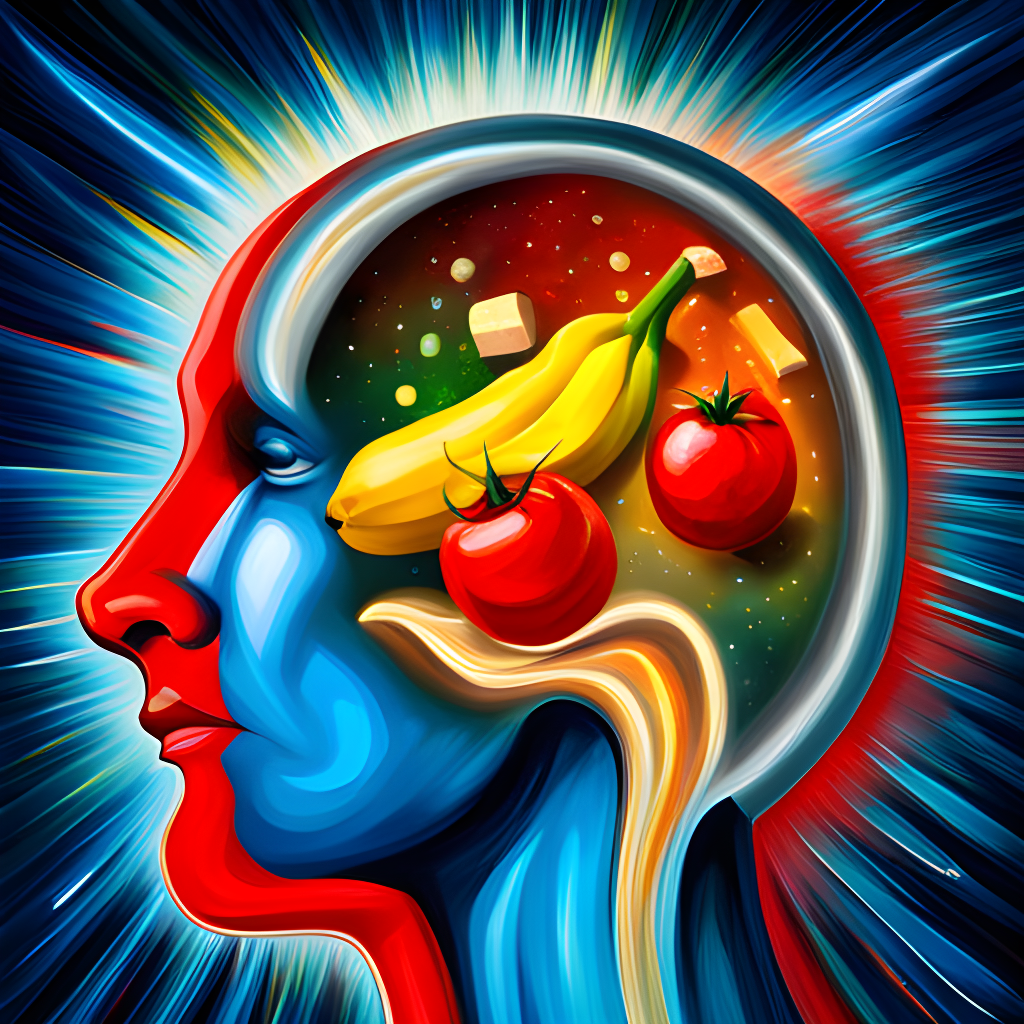
Figure 1: A brain! banana, tomato, children block cubes ideas inside the brain. A computer with electricity at the speed of light in the universe on the other side
What is the purpose of programming languages?
If you think about programming languages you really need to think about what are they for?.1
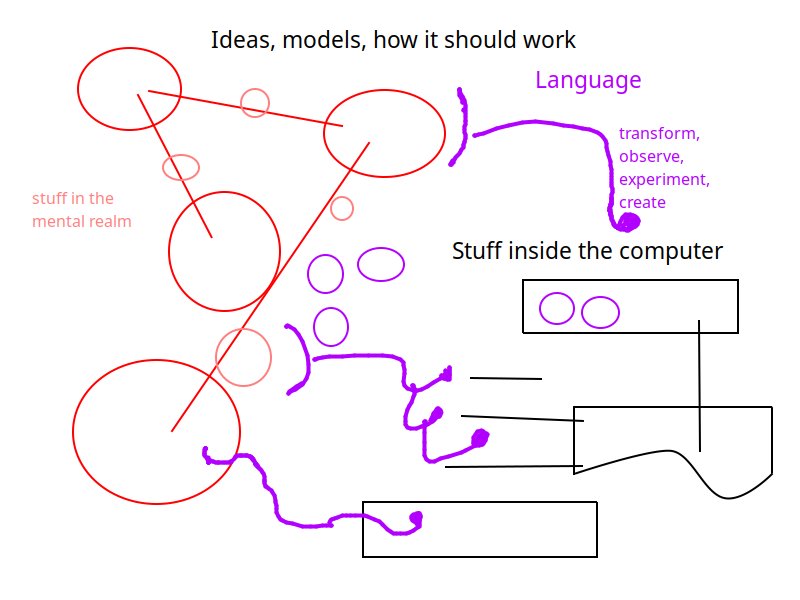
A programming language is what is between you and the computer.
It is the interface between the ideas on one side and the stuff inside the computer on the other side.
Maybe programming languages are for many things but here is a list of some really important things:
- Expressing ideas
- Expressing ideas to the computer
- Make the computer think what I think
- Make the computer tell me what it thinks
- Change some entity in the computer (file, process, … )
The first idea is that making a big computer program is building a larger process out of smaller ones. I suppose you could truthfully say that sculptors make large shapes from stuck-together grains of clay. But that shows what's wrong with the bits-and-bytes approach. No sculptor ever thinks that way, nor scientist, or programmer. An architect first thinks of shapes and forms, then walls and floors, and only last about how those will be made.
Minsky (1984)2
Data structures, language constructs, and at the very lowly bottom, syntax are the small things that are not what programming is about. The way that architecture is not about clay.
A language is there to allow us to modify, make experiments, and observe. Nothing more, nothing less.
Using this mental framework there is no fundamental difference between operating systems, programming languages, libraries, frameworks, user interfaces, and even text editors.3
These are all societies of processes, some with collections of members with different emphases.
The hypothetical ideal language is completely out of the way. It would have infinitely small friction, infinitely small steps, effort and wait time to make my ideas have effects on the computer. It would get rid of the clay entirely and we would rise higher and beyond as architects riding the ideas.
We would be able to instantly and losslessly transfer thoughts to the computer and make the program change to our desire. We would use the competence of the computer seamlessly intermingled with the rest of our thoughts. Experiments would be thinking, with perfect reach, perfect control, and perfect access to the vast competencies, memories and remote connections of the computer realm. Racing at an unknown pace, building new kinds of towers of abstraction, thought, reason and creative spirit. Eventually hooked up to some constructors,4 our thoughts would shape the stuff of the universe.
From this view, building ever more powerful languages is a path to a technological singularity.
Power is joy is getting stuff done is having effects on the computer
The most powerful programming language is Lisp. If you don't know Lisp (or its variant, Scheme), you don't know what it means for a programming language to be powerful and elegant. Once you learn Lisp, you will see what is lacking in most other languages.
Magic is what makes a great book great. It is something that happens in the mind of the reader, not elsewhere.
It has to do with masterful craftsmanship, with love, with the spark between people. It has to do with the right time and the right place, how could it be otherwise? A piece of magic comes together with the most masterful output of a masterful craftsperson. It needs to be the right time and place, else it would not be peak output.
We live in a world where we cannot measure magic yet. Otherwise, we could be churning out great movies, books and games.
You might not know it yet, but great software and great tools, too, are subject to taste and aesthetics.5
Would it not make sense that the people talking about the most powerful language in a sort of mysterious way would allude to taste, too? If it is the most powerful language, it would be powerful because of reasons in the realm of mastery and craftsmanship. It would be because of magic, which is hard to explain and only accessible via aesthetics and taste.
What makes Emacs a superbly sick piece of software? What makes The Man From Earth a superbly sick movie?
The answer is you will know when you know. But you will not know before you know. And you will know for reasons that you have to discover yourself. But it won't be reasons that make no sense. It will be reasons that make perfect sense. Just that they are somewhere where you don't yet know how to look.
The only way to know magic for the moment is to hone our tastes and broaden our horizons.
What does it mean to develop a taste in programming? Stallman is giving a hint that trying Lisp will develop your taste.6
Let me throw in another clue: in order to know what different kinds of languages do, you should go and try the ones that are most different from what you already know.
Lisp is mentioned in this way again and again.7 It will broaden your horizon, it will stretch what you think about languages.
Can it be true? Does it not sound too good to be true? Why not? What in reality doesn't look like it is true? Is it not a fact that Emacs, a Lisp program, is a freaking psychedelic spaceship? Is it not a fact that society and mainstream are wrong about things all the time?
If Lisp is profoundly more powerful than other languages, then it will be powerful in a way that
- resonates with your programmer's heart,
- you cannot know before you feel it,
- would be hard to explain, because it would be magic.
What is your most profound desire as a programmer? I think it is having effects on the computer.
What I am about to tell you is that there is an activity during programming that you sort of know but don't know. Current programming is stuck with a limitation that simply does not make sense.
Quick iterations are better
You want to make a quick experiment in the code. You make a little side project, and you set up some example data.
You tell your young programmers that they should value quick iterations. You jump through hoops to not have to re-compile right now. And not again. And you juggle in the right amount of changes in your batch so that afterward you see point 2/5 not working, instead of point 22/100.
You suffer when you have long deployment cycles in your feedback loop.
Sometimes you wish you had put a log or breakpoint somewhere because it just happened.
What if you have a complicated thing happening somewhere on the server? What if the program is right now in a state that, if only you could look at it, would tell you what to fix?
Sometimes it would be great to see the counterfactual quickly.
What if this if goes into the other branch, does it still work?
No, fuck it, commit, push, and tomorrow there is a bug report that x broke.
If you are faster at seeing what the program is doing, that is better.
This you know. And maybe you know from notebooks or some advanced hot reload tech what it would mean to be able to change the program while it is running.
Restart the program and the state is dropped on the floor. But if you see what it does, while it does it, that is a difference between night and day.8
Because it matters what is between you and the program.
Around 1959 to 1963, there were the MIT AI people, John McCarthy, Marvin Minsky, and the young bright-eyed hackers who later built the internet and influenced what computing is nowadays.9 Supported by J.C.R. Licklider, whose 1960 paper "Man-Computer Symbiosis" imagined people thinking together with an interactive computer, and who funded much of what followed.10
These people had a vision of what computing can be and they knew it would be interactive.
Batch processing
In batch processing, you give a batch of punchcards to a dude, who puts them into a computer, and you get your result the next day or whatever.
If you accidentally miss a hole or shuffle some cards, too bad. Dealing with the complexities of punchcards is not what programming is about! Not at all, not even close.
It is just extra steps and extra complexity in your interface to the computer.11 It is a bigger chasm, a bigger wall, a bigger world of pain. You want your ideas to affect the computer and then there is extra stuff. This stuff should not be there.
Getting rid of the punchcards and finding a better way was a tremendous step forward in computer programming.
Extra work between ideas and computers is not good.
It is easy to accidentally enjoy the puzzle12 that extra steps might provide. Don't do it. Don't enjoy it. It's darkness. Don't enjoy the extra steps between you and the computer, it is not programming.
You should be annoyed at all the things you do that are not programming. How else could we have moved away from punchcards?
Another similar mistake is to think that pain means hard work and that it makes you a serious worker. Don't do it. Don't enjoy the wrong pain for the right reasons. Don't think that being playful is opposed to getting stuff done. Otherwise, you remind me of what school is doing to the never-ending curiosity of young children.
We call brilliant programmers lazy because they are honing their tastes, to feel what is unnecessary pain. Pain is part of your programmer's intuition, your taste, your laziness.
Hence, the hackers and forward-looking people of their age fixed batch processing.
Interactive computing
Imagine you are programming, you stamp out a batch, give it to a dude and on the next day you get the error message forgot a comma.
It took brilliant people to see that this is not right. That there is a better way. That fast feedback even has any value at all.
Time-sharing was an idea for getting rid of batch processing.
Interactive computing is in general the idea that you get instant feedback from the computer about what you do.
For instance, you sit at a terminal and you type things. And the computer then answers, prints, some output.
Personal computers inherited interactive programming from the visionaries of early computing.13
Minsky tells the story of trying to sell time-sharing to IBM. IBM's research director asked:
Why don't people just think more carefully and write the program so they're not full of bugs?
Marvin Minsky, MIT Infinite History14
Meaning: why don't they spend the extra effort to just code bug-free the first time?
They were so wrong. So utterly, completely, badly, painfully, laughably wrong. Make songs about it, and etch it on the doors of buildings. Remember it forever and don't make the same mistakes again. Burn it in your souls for it is a wound. It held humanity back. It was a mistake.
If we were a bit more forward-looking and open-minded, how many times over would we be exploring the stars by now?
They thought interactive programming would not do anything. They thought the people who advocated it were just lazy and wanted to play, instead of doing serious things with the computer. And they argued in silly ways like how can the computer think if it is interrupted all the time?, a matter of implementation that was figured out.

Figure 2: bright-eyed hacker scientists Minsky, McCarthy, Licklider. joyful playful magic computers defeating the evil establishment. epic heist movie poster.
What does interactive computing have that batch processing does not have?
It is having a connection and an interface to the stuff inside the computer in a way that leverages how we evolved to manipulate and walk around in the world. It fits the human psyche. Its history stems from the urge to reach and explore inside the computer. And its effect is being able to reach into a new world. It was obvious to the brilliant visionaries of the time and it is obvious to us now, when we navigate and modify the stuff inside the computer.
To be clear, this is about what you feel when interacting with your operating system to create, move and modify files, for instance. When you open a browser and click things, this is interactive computing.
This is not a small thing. This is a different world we have. Interactive computing is arguably one of the most important technologies ever. And the big companies would never have come up with this. Would they even have had the incentive?
It is like having a spaceship where before you had hot air balloons. It is like the sun where before you had candles. It is something in the space between mind and machine, the ability to reach.
Next: why does Lisp make the same jump for programming a program?
One of the best ideas in computer science
And maybe one of the best ideas ever: the stored program, usually called the von Neumann architecture.15
Put the program into the computer memory.
A stroke of genius. Now we have a magic stone that can be loaded up with ideas and then it can be anything.
Before, we had 1 machine with 1 program. What a program is and what a machine is was glommed together. Good design is about splitting things apart, and this was a beautiful and elegant design.
This in a way resonates with Dennett's Tower of Generate-and-Test.16
First, you have a machine built to behave (Darwinian): a machine with a fixed program.
Then you have a machine that is built to learn (Skinnerian).
And finally (a von Neumann machine), a machine that is built to deal with ideas (Popperian).
Because ideas, the memes, can be anything, including ideas about ideas, the Popperian machine has an open-ended future.17
Putting more ideas into memory was a very good idea.
The story of dynamic memory data continues with IPL,
the language of one of the most important early AI works, the General Problem Solver (Newell, Shaw and Simon; begun 1957, published 1959).
In IPL, the Information Processing Language, you had dynamic data in the program, in lists (made from cells).
You can create lists and make them point to something else while the program runs,
instead of having to declare variables for everything.
You know of course what this means because you create lists and arrays all the time in your program.
JavaScript has a bit of Scheme in its genes: Brendan Eich was recruited to Netscape with the promise of "doing Scheme" in the browser.18
And it has a printer and a reader for its data: JSON.stringify and JSON.parse.
Douglas Crockford says he discovered JSON, rather than invented it: it was already there in how JavaScript writes its object literals.19
If you know the power of JSON, you know the power of having dynamic data in your program.
Your program is not about customers and payments, it is allowed to be a level higher. Your program is allowed to be
about data structures. Data abstraction is something like SQL or .NET LINQ, or a JSON parser.
It is a language for talking about data and data transformations. map, filter, reduce don't know about customer names,
they know about lists, sequences, streams.
This is the heritage of von Neumann's memory idea, propagated forward through time and one level up. Your program is loaded dynamically into the computer, but your program is also dynamically loading data into its memory. Your program is, in some way, simulating a von Neumann machine itself.
McCarthy took list processing from IPL, but not its assembly-like form, tied to one machine (the JOHNNIAC).20 He had the idea of taking those lists and describing the computer process entirely in terms of them.
Let's take those lists, make the first thing the verb and implement a lambda calculus.
To understand Lisp, imagine you read JSON and treat the data as a command language for what your program does next.
function read(expression) // returns jsonData
function eval(jsonData) // returns an evaluated object
Eval is the big meaty function of your program. It needs to take that JSON, go through it and interpret the data as commands.
function print(object) // print to the user
function repl() {
    while (true) {
        var whatTheUserSaid = readFromTerminal();
        var jsonData = read(whatTheUserSaid);
        var object = eval(jsonData);
        print(object);
    }
}
This repl function can be the entry point and the game loop of our program.
Now the user can sit at the console and interact with our language.
We define a few special operators. These are the things eval has to implement in the static part of the program:
set: set a variable.pair: make a pair; a pair of pairs then is alist.first: the first value in a pair.rest: the second value of a pair (this can be a simple value or another pair).lambda: make a function.if: conditional evaluation.quote: return the jsonData instead of evaluating it.
This is a program that is simulating interactive computing. Where an operating system gives you access to files and processes, a Lisp gives you access to a society of symbols, functions, values, and data structures.
var globalEnv = {}; // a dict, hash map, lookup table
function define(symbol, value) // augment the global env
Make our Lisp interpreter know about the command define.
function eval(expression) {
    if (expression[0] == "define") {
        var symbol = expression[1];
        var value = expression[2];
        define(symbol, value);
    }
    // ...
}
Lisp:
["define", "foo", 10]
(This is valid Bobscheme.)
This is the cleaning up that McCarthy did to computer programming. Lists where the verb is at the front, no extra stuff. Put it into memory so you can modify it while it grows. Make a symbol type so you can give names to things, from inside the language. Make a function type so that functions are the same stuff as the rest of the program.
The fact that JSON is so useful is passed down directly from list processing. All the objects nest, there are only a few kinds of objects, and it bottoms out at atoms.
A printer and a reader come shipped by default. I know without knowing that JavaScript gurus know the power of print,
compared to the little machines you get from the C++ line of heritage.
McCarthy wanted to sit at a terminal and make the program do different things while he was programming it. He did not want to say up front all the variables in the system, because he wanted something more dynamic for programming AIs.
The interactivity is at the bottom. Hence it is called a building material.
You make a program that asks you what should be next in the program?. It is as simple as this. From this, all the goodness that makes Lisp elegant and beautiful comes. The simplicity of this enables easy-to-reason-about programs that write programs.21
With this, we can have a conversation with the program. We can directly interact, while the program is running.
What it looks like in Clojure
Here is the conversation, concretely. A web server, started once:
(defn handler [req]
  {:status 200 :body "hello"})

;; pass the var #'handler, not the function value
(def server (jetty/run-jetty #'handler {:port 8080 :join? false}))
Now I change my mind about what the server says:
(defn handler [req]
  {:status 200 :body (str "hello, " (get-in req [:params :name] "stranger"))})
I evaluate this one form. The next request gets the new answer. No restart, no rebuild, and every other piece of state in the server is still there. That is not a faster iteration. There was no iteration. I told the running program something, and it listened.
And when a request does something strange, I keep it:
(defn handler [req]
  (def last-req req) ;; the real request, now a value in my REPL
  ...)
Then I call the pieces of the handler on last-req, one form at a time, until I see where it goes wrong.
The REPL has a new guest
Since I wrote this post, a new kind of programmer showed up at the REPL: the coding agent. On the Clojure codebase I work on, my agent evaluates forms in the same running REPL I use. It does not guess what a function returns from reading the source. It asks the program.
That is the same lesson the IBM research director missed, one more time. "Why don't they just think more carefully?" is what you would ask of a language model that only reads code. The better answer is the same as in 1960: give it a conversation with the machine.
Open questions:
- If agents converse with running programs, does "the source code" stop being the main artefact, and the running image become it again, as in Smalltalk?
- What does an agent need that a human at the REPL does not: a record of the conversation, a way to undo, a sandbox?
Conclusion
The power of Lisp is not quick iterations, but no iterations.
Instead of iterating, in Lisp and Smalltalk we have a conversation. This concept is reified in the read eval print loop.
It is enabled by the idea of putting the program into the dynamic memory of your program. This resonates with the von Neumann idea of putting the program into the memory of the computer.
Jack Rusher's bottom line is don't settle for anything with less interactivity than Lisp and Smalltalk!
In a Lisp program, you can write programs that write Lisp programs. So it has an open future. … to me, programming has not changed much in 50 years, because they got locked into this strange set of limitations.
Marvin Minsky, The beauty of the Lisp language
Once you have in your fingers how to leverage the repl, it will be as obvious as the sky, vast and inescapable.
This is better, this is simpler, and this gets stuff out of the way. This lets me use my brain the way a monkey reaches
for a banana. Directly, the way I can delete and create files on my PC. I can define and undefine symbols in the program.
I can make quick experiments while the program is running, without the mental distress of setting up the state.
It is the same difference that interactive computing makes compared to batch processing.
It is not a small step, it is not a big step, it is not a step at all. It is a different world.
Whatever that is. At this date and time, I will call it Magic.
See also
- Clojure and Interactive Programming
- Lisp
- Bobscheme, I make a toy Lisp implementation using JSON
GPT-4 can produce some poetic stuff with this post as base
Imagine a painter, fervently engaged in a dialogue with her canvas. Each stroke isn't a hurried message jotted down and sent off, anxiously awaiting feedback. No, the painter watches each trail of color blend and mix under her brush, immediately seeing the effects of her choices. She tries different pressure, strokes, colors, and brushes, in a cycle of continuous creation and observation, a dance between her mind's eye and the canvas. This is her conversation with her art - immediate, beautiful, and ever-changing.
Now, consider a programmer, in front of his screen. The code portrayed is not a fixed monolith of logic. Instead, it morphs, breathes, and reacts under his fingertips, mirroring that painter's canvas. The programmer writes a line of code, and the effects echo through the system immediately, no abstraction barrier held in between. The immediate feedback enables him to stir into different directions, tease out underrepresented nuances, debug on the fly and explore new vistas of his creation.
The code is fluid under the hands of the programmer in a perpetual dance of creation, modification, and observation. It is an intimate conversation with the ideational fabric that weaves itself into existence as the program - the programmers' thought reflections observed immediately, altered rapidly, and understood fully.
This, my friend, is the spirit of interactive programming. A live, pulsating creation constantly in flux rather than fixed scrolls etched into digital stone, navigating creativity at the speed of thought inspired by immediate feedback, riding the great prairies of abstraction and thought, reaching a level of intimacy and understanding with your program that feels like a piece of music resonating with your heartstrings.
Footnotes:
Introduction to LogoWorks, Marvin Minsky. The "society" picture of programs is his, too.
One benefit of this view is that I now hold all pieces of language, and interfaces, to the same high standard. React is not a framework, React is a language. Can I express myself using it?
My hunch: this is obvious to many people outside the industry, and the industry mentions it very little, to the point where you have to convince people that it is the case.
Paul Graham, The Taste Test. Exactly this concept: Succinctness Is Power.
Paul Graham, Succinctness Is Power, Beating The Averages.
LISP is worth learning for a different reason — the profound enlightenment experience you will have when you finally get it. That experience will make you a better programmer for the rest of your days, even if you never actually use LISP itself a lot.
It is indispensable for an artist to see what they are doing, while they are doing it. Bret Victor, Inventing on Principle.
McCarthy's time-sharing memo is dated 1 January 1959; Corbató's CTSS ran at MIT from 1961; Project MAC started in 1963 with ARPA money under Licklider. Multicians: Project MAC.
M. Mitchell Waldrop, The Dream Machine: J.C.R. Licklider and the Revolution That Made Computing Personal (2001). I cannot recommend this book enough. It is such an amazing ride through the history of computers.
See "Stop Writing Dead Programs" by Jack Rusher (Strange Loop 2022). This talk is such a beautiful rollercoaster ride through ideas of interactive programming. Very joyful, very quick-witted.
My hypothesis: this is one facet of why fewer women get into programming.
People who enjoy the needless pain of random puzzles and small IQ tests litter programming and source code with them. They even accidentally think that this is what programming is about.
But it is not. It is about ideas. The way architecture is about buildings, not the bricks.
When you just start with programming, how could you hope to have a mental framework to discern this? So you might think programming is a weird math-like, low-level activity that causes you pain.
Or you have the luck to start with Clojure. Then you will forever think what is all this extra gunk I need to do? in other languages.
This is just one of the many things that are off about mainstream programming and the software industry currently.
History of Unix. Interactive programming, and how Lick was central to pushing forward the right technology, is a major topic in The Dream Machine.
Quoted as Minsky tells it in the interview. John McCarthy, Reminiscences on the History of Time Sharing (1983), adds that he was surprised time-sharing was not IBM's own goal.
The "First Draft of a Report on the EDVAC" (1945) carried only von Neumann's name, but the ideas came out of work with Eckert and Mauchly, and Turing's universal machine (1936) came first in theory.
Dennett's Tower of Generate-and-Test: Darwinian, Skinnerian, Popperian and Gregorian creatures, in Darwin's Dangerous Idea (1995), expanded in Kinds of Minds (1996). A summary.
See for instance Dennett, From Bacteria to Bach and Back (2017).
Or accessible, some talks:
Brendan Eich, Popularity (2008). Management then required Java-like syntax; JavaScript took first-class functions from Scheme and prototypes from Self.
Douglas Crockford, The Discovery of JSON (2008).
John McCarthy, History of Lisp (1979): "There was little temptation to copy IPL", whose form was based on a JOHNNIAC loader; FORTRAN's algebraic notation was more attractive. See also Marvin Minsky - The beauty of the Lisp language.
The deeper trails are
- the Lisp and McCarthy Wikipedia articles,
- Paul Graham, What Made Lisp Different,
- Marvin Minsky (1967), Computation: Finite and Infinite Machines,
- McCarthy's website.
See Paul Graham, Beating The Averages. Other languages have macros too, for instance Template Haskell and Rust. My opinion is that Common Lisp-style macros are uniquely expressive and natural to reason about.
Generated by Claude on Benjamin Schwerdtner's behalf.